Custom Bandpass Filters
Narrow and wide bandpass interference filters designed at your working angle — for machine vision, sensing, astronomy and instrument programs.
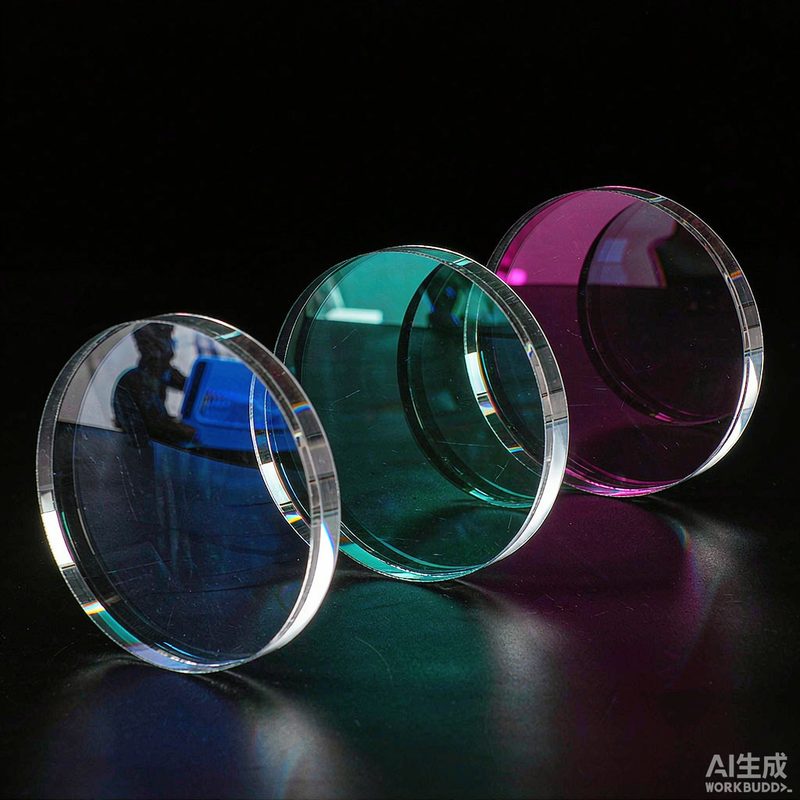
Specifying a Bandpass Filter
A bandpass filter is defined by the light budget around it, not by a catalog part number. The five decisions that set the design: center wavelength (CWL) and half-band width (FWHM), the edge steepness that gets you there, out-of-band blocking depth, angle of incidence, and the environment the part will live in.
For machine-vision and sensing programs we match common emitter lines — 450, 532, 635, 660, 808, 850 and 940 nm — with half-bands from tight 10 nm interference bands up to 40-80 nm widebands that tolerate LED spread and temperature drift. Blocking is specified as OD4 to OD6 across UV through far-red unless your program needs a notch kept open.
Coating, Substrate and Format
Designs run as hard (ion-assisted) coatings on polished BK7 or fused silica for field equipment, or soft coatings for bench instruments where cost rules. Round blanks from 12.5 to 50 mm and squares to 30 mm are stocked substrates; custom apertures and ring mounts follow. AR coating on the substrate faces keeps ghosting out of imaging paths.
Bandpass centers blue-shift with angle: an 850 nm filter at 45 degrees runs visibly short of its normal-incidence name. We design to the AOI stated on your drawing and budget edge steepness against it — this is the conversation catalog buyers skip and factories pay for in returns.
Verification per Lot
Every production run is measured on the Shimadzu spectrophotometer: transmission curve with CWL, half-band, peak transmission and blocking marked against the drawing acceptance box. The curve ships with the lot. Surface figure and dimensionals follow your tolerance class; standard sensing filters carry a practical production spec, and tighter figures are priced per requirement, not defaulted.
Frequently Asked Questions
What do you need to quote a bandpass filter?
CWL, half-band, blocking spec, AOI, substrate/format and quantity — a functional sentence is enough to start; the reply is a coating design proposal with the measured budget stated.
How tight can the center wavelength be held?
Production lot averages sit within a couple of nanometers of design on standard designs; per-piece windows are quoted per requirement against your detector's tolerance.
Wideband or narrowband for an 850 nm LED?
Usually wideband. High-power 850 nm emitters drift 10-30 nm with junction temperature; a 40-80 nm band keeps the signal through the drift and still kills ambient light.
Can you add a window or mount?
Yes — filtersepacers, mounted assemblies and windows with the bandpass integrated are in-house jobs; tell us the mechanical envelope.
Related Pages
Dichroic Filters & Beamsplitters
Longpass, shortpass and beamsplitting dichroic filters for fluorescence, projection, vision and illumination p
Neutral Density Filters
OD0.1 through OD3 neutral density glass and coated filters, stepped ND sets and graduated ND for imaging, lida
Black Mist & Creative Effect Filters
Black mist, soft-focus and creative effect glass filters for photography brands — wholesale tiers, retail-read
Wire-Drawing & Star Filters
6/12-point star, wire-drawing and streak filters for photography and stage — custom point counts and grades, w
Solar & Moon Astronomy Filters
Safe-grade solar filters (stark film and coated glass), full-aperture and telecope-mounted formats, plus moon
Aspherical Lenses
Aspheric lens production: molded glass and plastic aspheres plus polished aspheric surfaces for imaging, laser
Achromatic Doublets & Objectives
Cemented achromatic doublets, telescope objectives and coated lens assemblies — BK7/SF pairing, AR coated, mea
Send a drawing — or a paragraph.
Coating design proposals, tolerance advice and tiered pricing, from the engineers who run the coater.