Dichroic Filters & Beamsplitters
Edge filters that steer light by wavelength — longpass, shortpass and beamsplitting dichroics designed to your optical path.
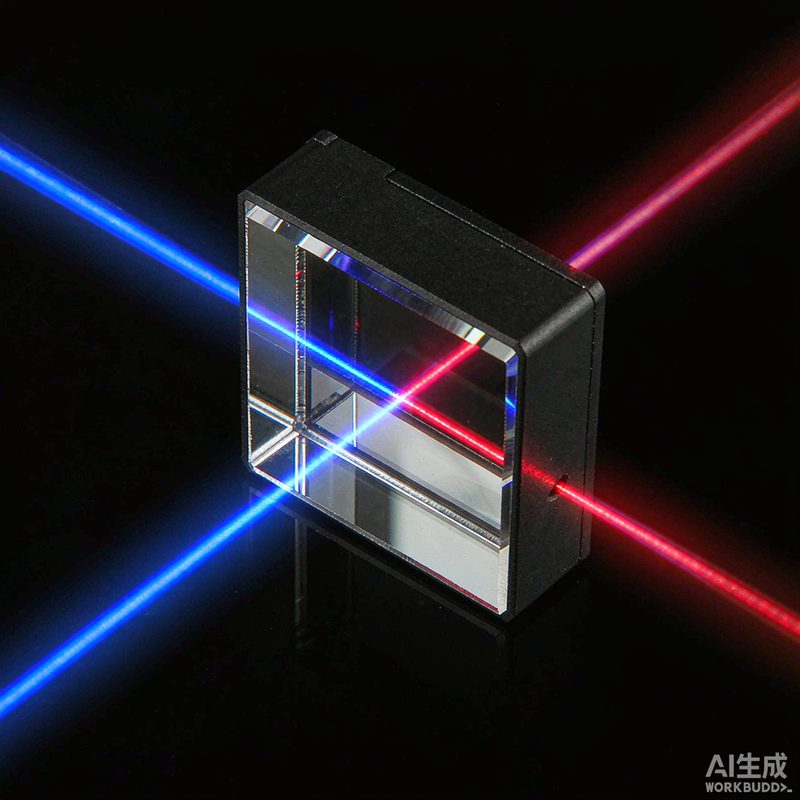
Edge Filters, Not Mirrors
"Dichroic" means the coating splits by wavelength rather than by angle like a metal mirror: pass the signal band, reflect the rest, with a steep edge between. We design longpass and shortpass stacks for sensor protection and illumination combining, and 50/50 through custom split-ratio beamsplitters for projection, interferometry and two-path vision.
The edge is the product. Steepness, edge-position tolerance and the blocking depth on the reject side are layer-count decisions — and they interact with angle. A dichroic specified at 45 degrees behaves differently at 0; every design here is specified at the working angle from your drawing.
Where They Work
Typical programs: 660/850 nm dual-band stacks for fingerprint and face sensors, longpass stacks that reject pump lasers while passing a signal band, UV/IR-cut combos for astronomy and machine-vision cameras, and cold mirrors that pull heat out of an illumination path before the light reaches the sample. Absorptive glass combinations are added where interference blocking alone leaks in wide-angle cones.
Substrates and Testing
Hard coatings on BK7 and fused silica for field and industrial duty; square formats for projection cubes and prisms, rounds for sensor windows. Each lot is measured across the pass and reject bands on the spectrophotometer, and wavefront is controlled where the part sits in an imaging path — a warped dichroic degrades the image long before the coating fails.
Frequently Asked Questions
Dichroic beamsplitter vs neutral beamsplitter?
Neutral (metallic) splits broadly and absorbs; dichroic splits by wavelength with minimal absorption in the pass band. If your system cares about color or band purity, the dichroic is the part.
Can you match an existing dichroic?
Given a measured spectrum we match functionally and frequently improve edge steepness or environmental performance. Send the curve before tooling talk.
What about damage threshold?
For high-power lasers we quote dielectric enhancement or metallic cold-mirror designs with the source power, wavelength and duty cycle stated — never guess a threshold from a catalog.
High-angle cones?
Edge filters degrade in steep cone geometries; absorptive elements are combined into the stack design. Quote your f-number with the edge spec.
Related Pages
Custom Bandpass Filters
Interference bandpass filters to your CWL and half-band: 450/532/660/850/940 nm sensing lines, astronomy bands
Neutral Density Filters
OD0.1 through OD3 neutral density glass and coated filters, stepped ND sets and graduated ND for imaging, lida
Black Mist & Creative Effect Filters
Black mist, soft-focus and creative effect glass filters for photography brands — wholesale tiers, retail-read
Wire-Drawing & Star Filters
6/12-point star, wire-drawing and streak filters for photography and stage — custom point counts and grades, w
Solar & Moon Astronomy Filters
Safe-grade solar filters (stark film and coated glass), full-aperture and telecope-mounted formats, plus moon
Aspherical Lenses
Aspheric lens production: molded glass and plastic aspheres plus polished aspheric surfaces for imaging, laser
Achromatic Doublets & Objectives
Cemented achromatic doublets, telescope objectives and coated lens assemblies — BK7/SF pairing, AR coated, mea
Send a drawing — or a paragraph.
Coating design proposals, tolerance advice and tiered pricing, from the engineers who run the coater.